
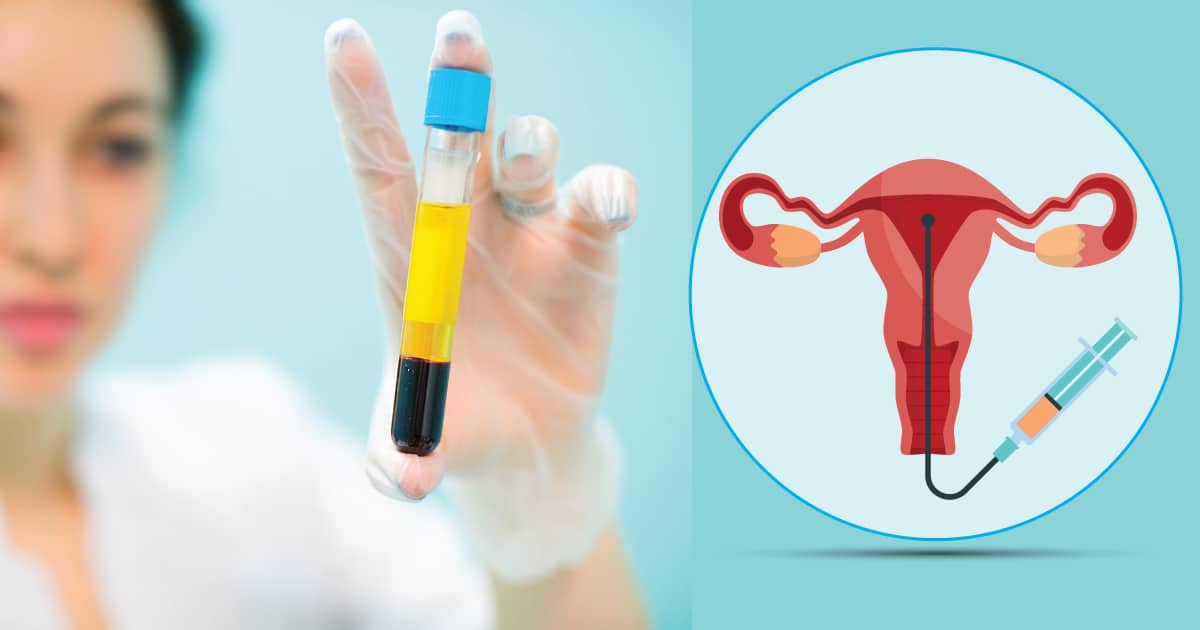
Endometrial PRP (Platelet-Rich Plasma) is a treatment in which a small amount of the patient’s own blood is processed to concentrate growth factors, then gently introduced into the uterine cavity. The aim is to support the thickness and quality of a thin or unresponsive endometrium ahead of an embryo transfer. Endometrial PRP is not a routine treatment and is not suitable for everyone. It is offered only to carefully selected patients, after a thorough evaluation by your doctor of your history, previous cycles and the cause of the problem.
Who May Benefit?
Selected patients whose lining stays thin despite adequate hormonal preparation, patients with repeated implantation failure after good-quality embryo transfers, and — as an addition to hysteroscopic treatment — patients with intrauterine adhesions (Asherman syndrome). In Asherman syndrome PRP is not a treatment on its own; the adhesions are first removed surgically, and PRP may help the lining heal.
Important Note
The scientific evidence for endometrial PRP is still developing, and international fertility guidelines do not yet recommend it for routine use. For this reason it is applied only after an individual assessment; results vary and nothing is guaranteed. PRP is prepared from your own blood (autologous); no donor or commercial product is used. It is not suitable during pregnancy, active pelvic infection, untreated abnormal bleeding, blood or platelet disorders, or active cancer. Other causes such as polyps or hormonal problems are checked and treated first.
How It Is Done
A small blood sample is taken and processed in the laboratory. The plasma is placed in the uterus through a thin, soft catheter, in the same way as an embryo transfer; it takes a few minutes and needs no anaesthesia. You go home the same day.
In selected patients with a lining-thickness problem, your doctor may decide, case by case, to apply PRP beneath the lining (subendometrial PRP) during a hysteroscopy instead. In every case, treatment is planned only after a medical pre-assessment and/or examination, review of your test results, and careful discussion with you.
Prices
- €550
- Hysteroscopic subendometrial PRP, if your doctor chooses it: €1,275 (diagnostic hysteroscopy €1,000 + PRP €275)
Our medical prices are fixed; your exact, all-inclusive price is confirmed in writing after your consultation. See our full price list →
Timing
The procedure is done after your period has ended — never during menstrual bleeding.
Contact UCARER Women’s Health to book your consultation with Assist. Prof. Dr. Muzaffer Uçarer.